Introduction
In Formal Concept Analysis (FCA), a bond between two formal contexts and is a relation such that:
- For every object , the set of attributes is an intent of .
- For every attribute , the set of objects is an extent of .
Bonds represent “compatible” relations between the objects of one context and the attributes of another. Mathematically, the set of all bonds between two contexts, ordered by inclusion, forms a complete lattice called the Bond Lattice.
In fcaR, bonds are treated as first-class citizens with
a dedicated BondLattice class that extends the standard
ConceptLattice.
Computing Bonds
The main function to compute bonds is bonds(). It takes
two FormalContext objects as input.
To keep this example fast, we will generate two small random formal contexts ().
set.seed(42)
# Context 1
mat1 <- matrix(sample(0:1, 16, replace = TRUE), nrow = 4, ncol = 4)
rownames(mat1) <- paste0("O", 1:4)
colnames(mat1) <- paste0("A", 1:4)
fc1 <- FormalContext$new(mat1)
print(fc1)
#> FormalContext with 4 objects and 4 attributes.
#>     A1  A2  A3  A4
#>  O1      X
#>  O2      X   X   X
#>  O3      X
#>  O4      X   X

# Context 2
mat2 <- matrix(sample(0:1, 16, replace = TRUE), nrow = 4, ncol = 4)
rownames(mat2) <- paste0("P", 1:4)
colnames(mat2) <- paste0("B", 1:4)
fc2 <- FormalContext$new(mat2)
print(fc2)
#> FormalContext with 4 objects and 4 attributes.
#>     B1  B2  B3  B4
#>  P1  X
#>  P2  X       X
#>  P3  X           X
#>  P4  X           X
To compute the bond lattice:
bl <- bonds(fc1, fc2, method = "conexp")
bl
#> Bond Lattice between two formal contexts:
#> - Context 1 (G1): 4 objects (O1, O2...)
#> - Context 2 (M2): 4 attributes (B1, B2...)
#> - Total Bonds: 16
Computation Methods
The bonds() function provides two optimized C++
methods:
-
"conexp"(Default): Uses an implication-based approach on a tensor product of the contexts. It is generally the fastest for dense or moderately sized contexts. -
"mcis": A backtracking algorithm that operates directly on the pre-computed concept sets of both contexts. It can be more efficient in specific structural configurations.
# Using the backtracking method
bl_mcis <- bonds(fc1, fc2, method = "mcis")
bl_mcis$size()
#> [1] 16
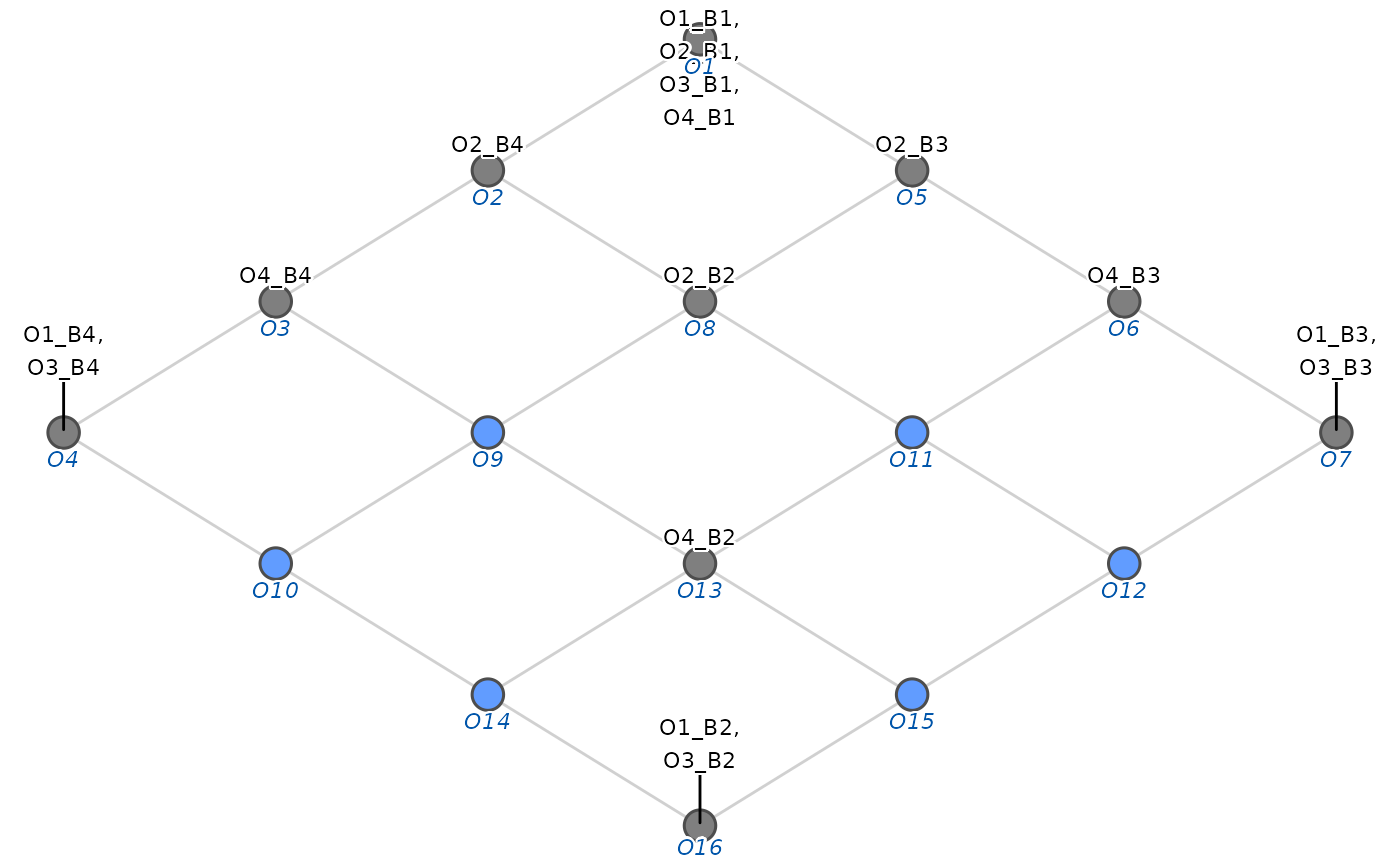
The BondLattice Object
The result of bonds() is an object of class
BondLattice. Since this class inherits from
ConceptLattice, you can use all standard lattice
operations.
Extracting Bonds
Each node in the bond lattice represents a specific bond (a
relation). You can extract these relations as individual
FormalContext objects:
# Get all bonds as a list of FormalContexts
all_bonds <- bl$get_bonds()
length(all_bonds)
#> [1] 16

# Inspect the first non-trivial bond
# (Note: Bond 1 is usually the "Core" or minimal bond)
all_bonds[[1]]
#> FormalContext with 4 objects and 4 attributes.
#>     B1  B2  B3  B4
#>  O1  X
#>  O2  X
#>  O3  X
#>  O4  X
Verifying Bonds
If you have a relation (as a matrix or a FormalContext)
and want to check if it satisfies the mathematical definition of a bond
between two contexts:
Similarity and Complexity Metrics
The BondLattice class provides a
similarity() method to compute various metrics that
describe the relationship between the two formal contexts.
The following metrics are available. Let be the bond lattice between and , and and be the bond lattices of and with themselves, respectively. We denote the size (number of concepts) of a lattice as .
-
log-bond: Measures how much the two contexts share a common logical structure. It is calculated as the normalized log-ratio of bonds: -
complexity: Ratio of irreducible bonds to total bonds. Lower values indicate more emergent structural properties. Let be the set of join-irreducible elements of the bond lattice: -
core-agreement: Ratio of filled cells in the Core bond versus the Top (largest) bond. If is the Core bond and is the Top bond, and represents the number of elements in the relation (filled cells): -
entropy: Based on the log-size of the lattices. It measures interaction entropy as:
The similarity() method returns a named vector of these
metrics.
# 1. Logical Affinity (Log-Bond)
# Measures how much the two contexts share a common logical structure.
# 1.0 means perfect affinity.
bl$similarity("log-bond")
#> [1] 0.9620358

# 2. Structural Complexity
# Ratio of irreducible bonds to total bonds.
# Lower values indicate more emergent structural properties.
bl$similarity("complexity")
#> [1] 0.375

# 3. Core Agreement
# Ratio of filled cells in the Core bond versus the Top (largest) bond.
bl$similarity("core-agreement")
#> [1] 0.25

# 4. Interaction Entropy
# Based on the log-size of the lattices.
bl$similarity("entropy")
#> [1] 0.4806578
Order-Theoretic Properties
Bonds also allow exploring deep structural properties of the interaction between contexts using measures like Width and Dimension.
- Dilworth’s Width: The size of the largest antichain in the bond lattice.
- Order Dimension: The minimum number of linear orders whose intersection is the bond lattice.
# Dilworth's Width
bl$similarity("width")
#> [1] 4

# Order Dimension (estimated via heuristic)
bl$similarity("dimension")
#> [1] 2
These measures can also be expressed as indices normalized by the lattice size:
- Width Index:
- Dimension Index:
bl$similarity("width-index")
#> [1] 0.25
bl$similarity("dimension-index")
#> [1] 0.5
Summary
Bonds provide a powerful mathematical framework to analyze the
alignment or interaction between different perspectives (contexts) on
the same objects or attributes. With fcaR, you can
efficiently calculate large bond lattices, visualize them, and extract
meaningful metrics to quantify context similarity and structural
emergence.